By The Alder Group
We've worked in Tucson long enough to know that the city consistently surprises people — including people who thought they already had a pretty good picture of it. Whether you're considering a move, planning a visit, or have lived here for years, Tucson has a depth of history, culture, and distinction that most people haven't fully explored. Here are some of the things we find ourselves sharing with buyers and newcomers that tend to stop people mid-conversation and make them look at this city a little differently.
Key Takeaways
- Tucson is one of the oldest continuously inhabited places in North America
- The city holds a UNESCO designation that no other American city had claimed before it
- The surrounding landscape contains some of the most ecologically significant terrain in the Western Hemisphere
- Tucson's contributions to science, defense, and the arts carry global significance
Tucson Is One of the Oldest Continuously Inhabited Places in North America
Before there was an Arizona, before there was a United States, people were living in the Tucson Basin. The Hohokam people developed sophisticated irrigation systems along the Santa Cruz River more than 4,000 years ago — canals that in some cases still influence how water moves through the valley today. The village of Stjukshon, from which Tucson takes its name, was already an established settlement when Spanish missionaries arrived in the late 1600s. That continuity of human presence is genuinely rare on this continent.
What That Deep History Looks Like Today
- The Tumamoc Hill archaeological preserve protecting over 4,000 years of continuous human occupation within the city limits
- Mission San Xavier del Bac, completed in 1797 and still an active parish — one of the finest examples of Spanish Colonial architecture in the United States
- The Arizona State Museum on the University of Arizona campus housing one of the largest collections of Southwest Indigenous materials in the world
- The Santa Cruz River park system tracing the corridor where Tucson's earliest communities took root
Tucson Was the First American City to Receive a UNESCO Gastronomy Designation
In 2015, Tucson became the first city in the United States to be named a UNESCO City of Gastronomy — a designation that recognizes food cultures with deep historical roots and ongoing culinary innovation. This isn't a marketing title. It reflects a food tradition anchored in Indigenous and Spanish Colonial agricultural practices, a climate that supports year-round growing, and a culinary community that has preserved and evolved those traditions across generations.
What Makes Tucson's Food Culture Genuinely Distinctive
- The Sonoran hot dog — a regional original with a loyal following that extends well beyond city limits
- A chile agriculture heritage rooted in varieties grown in the region for centuries
- Native seed preservation efforts led by organizations like Native Seeds/SEARCH protecting over 1,800 plant varieties tied to the Southwest's food history
- A restaurant and chef community that draws on this heritage while producing food that earns national critical attention
The Surrounding Sky Islands Are a Global Ecological Phenomenon
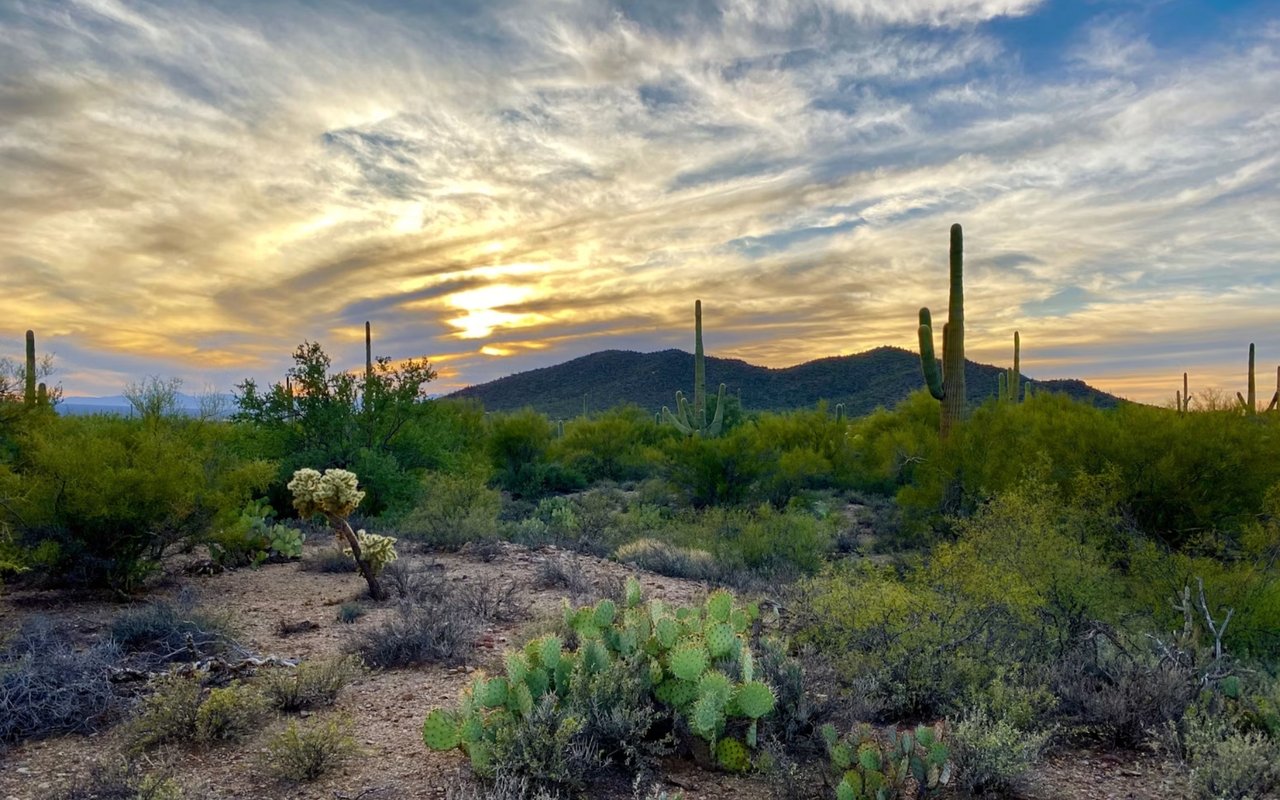
One of the most remarkable Tucson, Arizona, facts that most residents don't fully appreciate until someone points it out: the mountain ranges surrounding the city are classified as sky islands — isolated mountain ecosystems that rise from the desert floor and support biodiversity found nowhere else on earth. The Madrean Archipelago, of which Tucson's surrounding ranges are a central part, is one of the most biologically diverse regions in North America.
What Makes the Sky Island Ecosystem So Significant
- More bird species pass through or reside in the Tucson region than almost anywhere else in the United States — a fact that draws birdwatchers globally
- The convergence of Rocky Mountain, Sierra Madrean, Chihuahuan, and Sonoran Desert species creates overlapping ecosystems of extraordinary complexity
- Rare and endemic species — including the Elegant Trogon and multiple jaguar sightings — found in ranges within an hour of downtown Tucson
- Ramsey Canyon, Madera Canyon, and the Chiricahua Mountains offering world-class wildlife observation accessible as day trips from the city
Tucson Has Deep Connections to American Space and Defense History
Davis-Monthan Air Force Base has been a fixture of Tucson's identity since 1927, and its presence has shaped the city economically, culturally, and architecturally for nearly a century. But Tucson's connections to aerospace and defense extend well beyond the base — the University of Arizona's Lunar and Planetary Laboratory has contributed instruments and research to missions across the solar system, and the region's dark skies support some of the most significant astronomical research on the planet.
Tucson's Contributions to Science and Defense
- The AMARG facility at Davis-Monthan — the world's largest aircraft storage and preservation center, housing thousands of military aircraft in the dry desert climate
- The University of Arizona's role in developing instruments for NASA's Mars Phoenix Lander, the Hubble Space Telescope, and multiple other missions
- Kitt Peak National Observatory, less than an hour from downtown, hosting one of the largest collections of optical telescopes in the world
- Raytheon Missiles and Defense, headquartered in Tucson, representing one of the largest private employers in Southern Arizona
Frequently Asked Questions
Why does Tucson have such strict outdoor lighting ordinances?
Tucson and Pima County adopted some of the first dark sky ordinances in the world — dating back to the 1970s — specifically to protect the astronomical research conducted at Kitt Peak and the University of Arizona observatories. The result is a city where the night sky is genuinely visible in a way that most urban areas can't claim, and where the ordinances have become a point of civic pride as much as a scientific necessity.
What is the significance of the saguaro cactus to Tucson specifically?
The saguaro is native exclusively to the Sonoran Desert, and Tucson sits at the heart of its range. Saguaro National Park — split into east and west districts that bracket the city — was established specifically to protect the saguaro forests that define the region's landscape. A mature saguaro can live 150 to 200 years and weigh several tons, and they're protected under Arizona state law — harming one carries serious legal consequences.
Is Tucson really one of the best stargazing cities in the world?
By most measures, yes. The combination of high elevation, low humidity, minimal light pollution relative to city size, and over 300 clear nights per year creates stargazing conditions that draw astronomers and enthusiasts from around the world. The Tucson area hosts more telescopes per square mile than almost any comparable region, and the annual Tucson Amateur Astronomy Association events draw participants from across the country.
Contact The Alder Group Today
Tucson is a city that rewards curiosity — and the more you learn about it, the more reasons you find to want to be here. We've built our careers in this community because we believe in it genuinely, and we love sharing what makes it worth choosing with every buyer and newcomer we work with.
When you're ready to explore what Tucson has to offer, reach out to us at
The Alder Group. We'd love to introduce you to the city we call home.