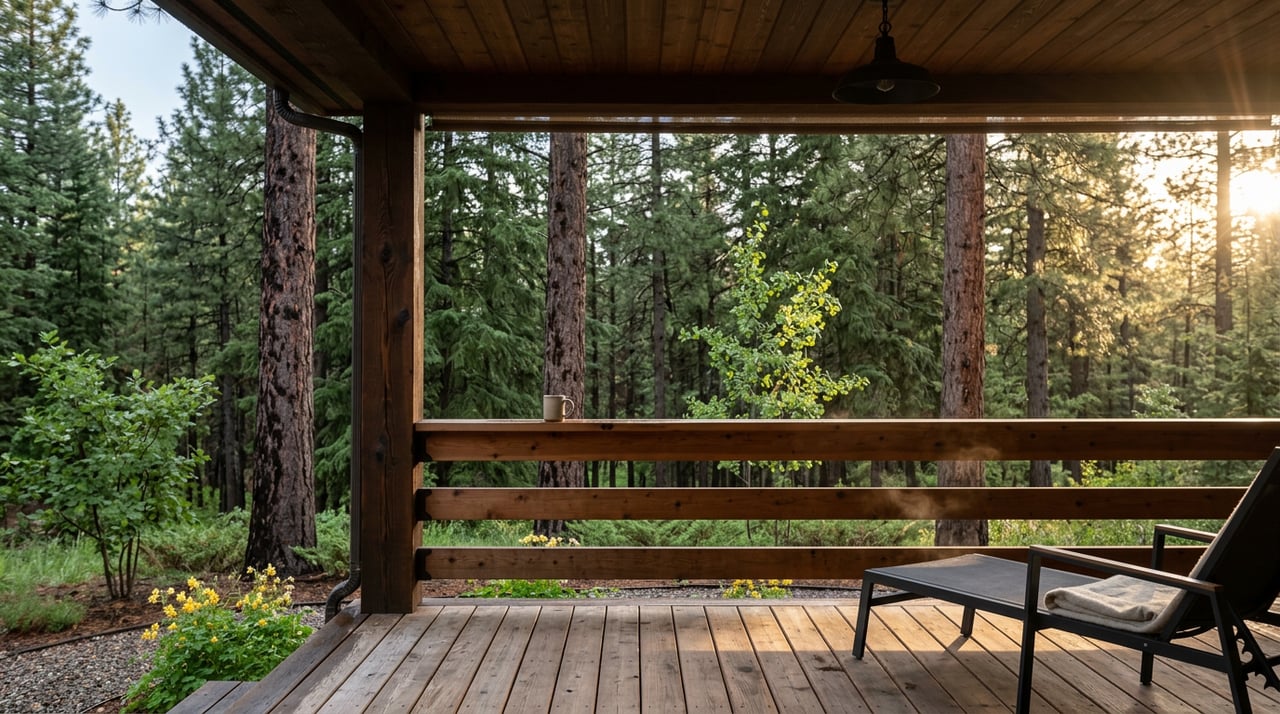
The best week of the year on this mountain is not in ski season. It is right now, in the first heavy pulse of the monsoon, when the meadows above Summerhaven go green in a way they simply do not the other eleven months. If you live up here, or your cabin has been in the family since the Control Road was still one-way gravel, you already know this. The point of this post is to argue that the storm window is the reason to stay put, not the reason to drive back down.
Most Tucson visitors treat Mt. Lemmon as a heat-escape day trip. Residents get something the day-trippers do not: the afternoon after the rain, when the pines smell like they were just unwrapped and the trails are quiet because everyone who came up in the morning has already gone home.
Summerhaven averages 25 to 30 inches of precipitation a year, with the majority falling during the North American monsoon from July to September and contributing 10 to 15 inches through intense thunderstorms. Set that against the desert floor, which sees roughly a third of that annual total, and the picture shifts. This is not "a wetter time of year." This is a distinct climate zone briefly behaving like one.
The temperature story is the same trick told differently. Mt. Lemmon runs 20 to 30 degrees cooler than Tucson, and at a summit of 9,159 feet it is the highest point in the Santa Catalina range. That gap is at its widest in July, when the valley sits at 105 and the village sits in the 70s under a sky that keeps threatening.
Rain is one thing. Water on the ground is another. A few specific places on the mountain read the monsoon most visibly:
The wildflower story is worth pausing on. Most mountains in the Southwest bloom once, in spring. Mt. Lemmon does it twice. Some wildflowers bloom near the start of spring, and others start blooming around the monsoon, offering splashes of color across the mountainside. Red penstemon, golden columbine, and yellow blooms along the Meadow Trail all key off July rain. In wet years, a single naturalist reported finding 46 species flowering near the top of the mountain after 5 inches of rain since early July.
Summerhaven is small enough that a rainy afternoon changes the entire rhythm of the day. The trick is knowing which doors are worth pushing open.
Sawmill Run runs a menu of burgers, sandwiches, and appetizers like poutine, and Iron Door has been serving mountain specials such as green chile quiche since at least the late 1970s. Beyond Bread and Mt. Lemmon Coffee and Tea Co. round out the daytime options. The Cookie Cabin still draws the longest weekend line in the village, and the sampler with every cookie they make plus ice cream on top is worth arriving hungry for.
For gifts and browsing, Sky Island Trading Co. sits tucked into the basement of a log cabin off the main road and stocks a rotating selection of Southwest-made goods, including spices and salts from Tucson-based Desert Provisions and candles from Phoenix's Vim and Vigor Candle Co. Living Rainbow Gift Shop and the General Store cover the rest, with the General Store still turning out homemade fudge as it has for decades.
The lodging picture on the mountain used to be cabin-only. That has changed in the past five years. Mt. Lemmon Hotel opened in 2021, and Mount Lemmon Lodge opened in 2023. The Lodge in particular has quietly become the summer programming engine of Summerhaven. It hosts Movie Nights on the deck the first Friday of every month at 7:00 p.m., and live music by local musicians every weekend from May through October. A cedar-scented Swedish sauna sits near the forest's edge, and the Lodge runs a stargazing series with wine by fire pits, an outdoor movie screen, and guided Saturday nature hikes via Southwest Discoveries. Even for people who live five minutes away, the deck is a legitimate weeknight option.
The storms tend to move through in the afternoon and leave the sky washed by dusk. That is when the mountain earns its second reputation.
The University of Arizona's Mt. Lemmon SkyCenter at the top of the mountain runs SkyNights Programs, Astronomer Nights, and guided day tours of the observatory grounds. Programming lives at skycenter.arizona.edu, and the address is 9800 E Ski Run Road. A clear post-monsoon night at 9,000-plus feet is not a marketing claim. It is a physics claim.
If the storms are still building and the sky is not cooperating, the Ski Valley chairlift runs summer service and delivers a different reward. Mt. Lemmon sits inside Arizona's Sky Islands and hosts more than 200 bird species across desert and mountain habitats, with Rose Canyon Lake best for waterfowl and songbirds, Oracle Ridge for warblers and woodpeckers, and Marshall Gulch for Elegant Trogons and Painted Redstarts. The lift itself is a lazy way to cover 45 minutes of elevation change with a coffee in hand.
A last section for anyone still calibrating to full-time or heavy-seasonal life on the mountain. These are the pieces of local knowledge that come up in real conversations, not in guidebooks.
Bears are active this spring. In early May 2026, residents on the Summerhaven Nextdoor board posted multiple sightings of a sow and cub moving through the village, along with a small bear at 12717 N Tucson Ave and another at 11180 E Turkey Run. The neighborhood reminder that circulated with those posts holds year-round: keep trash indoors, bring in bird feeders, and never feed a bear.
There is no gas and no public trash service. There are no gas stations in Summerhaven, so fill up in the valley at Tanque Verde and Bear Canyon before the drive up. Trash gets taken back down to Tucson because there is no public service on the mountain. Cabin renters figure this out fast. New owners occasionally do not.
Time your hikes. Hiking near the summit can be dangerous if monsoon thunderstorms are in the area. If the weather looks threatening on arrival, postpone the hike; anyone caught out should seek a low-lying area away from tall trees. Morning is almost always the right call from late June through early September.
The Fourth still means the parade. The Summerhaven Fourth of July parade marked its 49th year in 2024, drawing hundreds of participants through the village. If you are a resident reading this on the fifth, you already know. If you are new, put it on next year's calendar the way you would a birthday.
There is a version of Mt. Lemmon ownership that treats the cabin as a winter and shoulder-season asset and mostly closes the door in July. This is the more common pattern than most owners admit. The argument here is narrower and, we think, more useful: the monsoon window is when the mountain is most itself, and it is the window most likely to convert a "we should sell the cabin" conversation into a "we should come up more" one. The wildflowers are free. The rain is free. The Lodge deck on a Friday in July is close enough.
If you own on the mountain and are starting to think about what to do with the place, or if you are shopping the Foothills and Oro Valley for a primary and want a Summerhaven cabin as a second address, we can talk through what the current inventory looks like without any pressure to list. Reach out to The Alder Group and we will meet you where you are, coffee on the Lodge deck if the timing works.
100 N Stone Ave, Suite 100 Tucson, AZ 85701
100 N Stone Ave, Suite 100 Tucson, AZ 85701